

Sexual Harassment Review: March Update
March 2026 update - A message to all Corrections staff from Deputy Chief Executive (DCE) People & Capability Rebecca Powell
Kia ora koutou,
Welcome to my first update for 2026 on our work to eliminate workplace sexual harassment at Corrections.
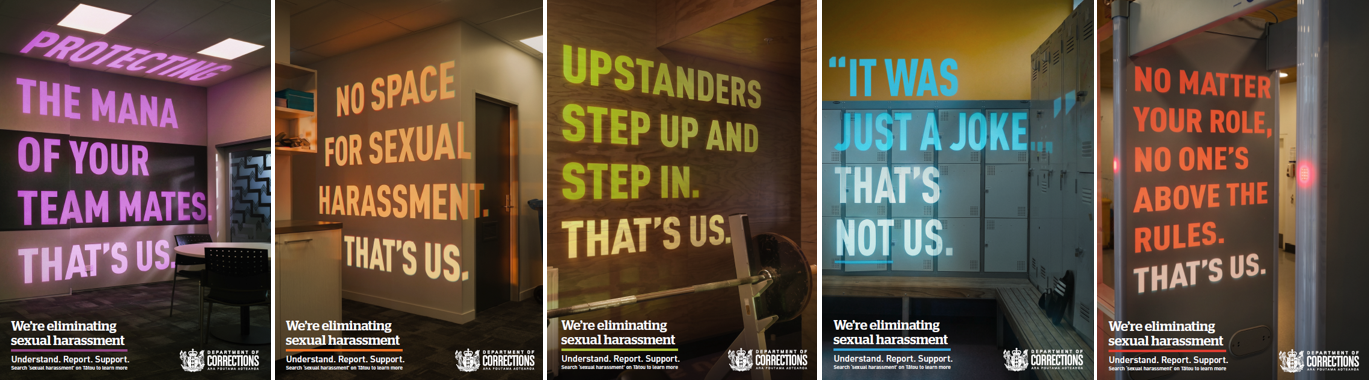
Ensuring that every single one of our staff, at every single one of our sites, understands what sexual harassment is and has the capability and confidence to intervene when they see it happening is a top priority. While posters alone won’t achieve this, they are important tools in our approach. Last month you will have seen the launch of That’s Us – our new sexual harassment awareness campaign. The conversations that the campaign will spark, and the actions they prompt, will move us closer to eliminating sexual harassment from our workplaces.
If you haven’t already, I encourage you to:
- take a look at our new Reflection Sheets for individual and group reflections
- sign up for a sexual harassment workshop on our Hub, if you haven’t already
- become familiar with the information and resources available
- learn about how to raise concerns, or about what support options are available.
Ensuring a safe and effective response
It’s important to me that we understand what best practice in the elimination of sexual harassment looks like. To this end, we have partnered with RespectEd Aotearoa, an organisation which specialises in the prevention of sexualised violence and its harm.
We will be engaging with RespectEd on key decisions and initiatives to ensure our approach is appropriate, safe, and best placed to deliver the kind of change we are seeking.
Strengthening our complaints process
We know that many of our people do not feel safe to report concerns and have a lack of trust in our current sexual harassment complaints process.
Concerns about inconsistency, confidentiality, timeliness, and fairness are real and must be addressed. That’s why we have started work to develop a new complaints response model to:
- provide clear and accessible pathways and processes for speaking up
- ensure concerns are taken seriously and handled fairly, consistently, and with accountability
- build trust so staff feel safe and supported when raising issues.
The new model is being designed to deliver an appropriate level of individualised response and care, centred around the experiences of people who are involved. It will provide detailed, clear guidance to decision-makers, complainants and respondents to ensure consistency. It will also provide clarity around next steps and will outline more transparent escalation processes.
This work will also involve strengthening governance and oversight, as well as our investigation processes and reporting. Another key consideration is ensuring the model enables people who are impartial (ie. do not know the complainant or respondent) to take a lead role in managing cases, so that our processes produce fairer outcomes.
The input of our staff reference group, our union partners and our independent subject matter experts at RespectEd will be key to how we progress the model, and I look forward to sharing more information about this with you soon.
Introducing Working at Corrections: Our Code of Conduct
Today we introduced Working at Corrections: Our Code of Conduct, which covers the behaviours expected of all staff and contractors who work for us.
Our refreshed Code is also now a formal People Policy, which provides a clearer framework for expectations, behaviour and accountability. It has been designed to reflect today’s Public Service environment and aligns with the Public Service Act 2020 and the PSC’s own Code of Conduct for public servants.
Working at Corrections: Our Code of Conduct places our values at the centre of everything we do. Each of our values now have clear, practical behavioural examples so you can more easily understand what these values look like in practice. You can read more about our new code of conduct on Tātou.
Please make sure you have read and understood our refreshed Code and confirm that you have done so by completing the task you have received within āwhina. The refreshed Code comes into effect on Monday 1 June 2026.
Why your involvement matters
A common question I’ve been hearing is: “I’m not sexually harassing anyone. Why do I need to attend workshops and team discussions, or read resources?”
Your time is precious and I recognise the pressure many of our people are under. But learning more about sexual harassment, and how to be an effective Upstander, means you’ll be ready to speak up for a colleague, challenge harmful behaviour, and intervene when it counts most.
Your visible commitment also sends a powerful message to your colleagues: sexual harassment has no place here. Our culture will shift when people see others step forward.
Finally, a big thank you to everyone who has taken a step forward towards supporting our plan to eliminate sexual harassment. As I’ve said, it will take all of us playing our part for us to be successful in our goal. If you have any questions related to this work, please feel free to get in touch with me directly.
Ngā mihi nui,
Rebecca