

Sexual Harassment Review: July Update
Kia ora koutou,
Many of you will have seen Chief Executive Rachel Leota’s message last month, including her acknowledgement of the work underway to prevent and respond to sexual harassment at Corrections. Rachel took part in our Understanding and Responding to Sexual Harassment workshop and also chaired her first meeting of the steering group that oversees our work programme. She’s a passionate advocate for safety, integrity and respect and will continue to strongly sponsor our work to eliminate sexual harassment in our workplaces.
When I first stepped into the role of leading this work, I knew how important it was to the culture we want to create together, and I wanted to do it well. Looking back, one of the things I’ve learned is that this work is both deeply important, and at times, challenging. It asks us to reflect on ourselves, our behaviours, and the environment we create for others. I know that challenge is felt by others too.
Over the past year, one of the most rewarding aspects has been the level of enthusiasm and commitment from our people across the organisation. Leaders and teams are progressing actions across our four shifts – knowledge, speak up, support and prevention.
Every fortnight, the Sexual Harassment Working Group comes together to share what we’re hearing, what’s working, and where we need to focus next. Those conversations matter as they help keep this work grounded in the real experiences of our people, not just policy or intention.
One of the strongest signs of progress I am seeing is that the conversations happening today are different from those a few years ago. Expectations are clearer. Behaviours are being called out. People are feeling more empowered to speak up. More people are stepping into the role of an upstander - saying, “That’s not how we do things here.”
Every time someone speaks up, they shift what is acceptable. They reinforce the standards we’re trying to build, and they make it easier for the next person to do the same.
While there is still more to do, I am encouraged by the signs that respectful, supportive and safe behaviours are becoming part of our everyday culture. We’re seeing evidence that we are gaining traction and continuing to make progress in these important areas.
Media coverage about complaints we are managing
You may have seen recent stories in the media about a range of complaints being investigated by Corrections. Media organisations play an important role in reporting matters of public interest, and I agree that there is legitimate public interest in how Corrections is providing safe working environments for our people and managing complaints appropriately.
When responding to media enquiries, we carefully balance this public interest with our duty of care to the people involved, and our obligation to manage personal information in accordance with the Official Information Act and the Privacy Act. We ensure that both the person who has made the complaint, and the person the complaint is about, are aware of media interest, and we remind them of the support available to them. Despite our best efforts to act with care and sensitivity, I recognise that media attention can be very distressing for everyone involved.
I have also heard from a number of people that concerns about matters becoming public are making them think twice before bringing forward a complaint. From my perspective, this is the worst possible outcome, because it undermines our ability to create a safe workplace. People must feel confident that they can come forward and be heard, and that their privacy will be respected.
In order to provide assurance to impacted staff, we have recently carried out checks to ensure that only authorised staff have access to our HR records and completed an IT search to confirm that no personal information had been inappropriately distributed externally, with nothing found. However, it can be very difficult to determine how confidential information reaches the media.
What is clear is that maintaining trust and confidentiality is critical to the integrity of our processes and to the safety and wellbeing of our colleagues. We all have a role to play in this. Respecting the privacy of others and not sharing sensitive information helps ensure that people feel safe to come forward and that we can respond appropriately when they do.
Building capability where it matters
Since the start of this work, over 30% of our workforce (more than 3,600 people!), have now completed our sexual harassment workshops. This is a significant milestone for us, because the research shared with us by RespectEd Aotearoa shows if 21-30% of a workforce become active participants in this type of culture change, we will greatly increase our chance of success.
We’ve seen strong engagement from across our sites, with face to face sessions in prisons continuing to be a priority, with General Managers and site leaders actively supporting participation.
Workshop participants often tell us they’ve already seen the posters, heard colleagues talking about respectful behaviour, or noticed changes in their teams. The language and expectations are becoming more visible and more familiar.
Anecdotally, I’ve been informed that a number of people who have come forward to report sexual harassment recently were motivated to do so, in part, due to our workshops and our awareness campaign That's us.
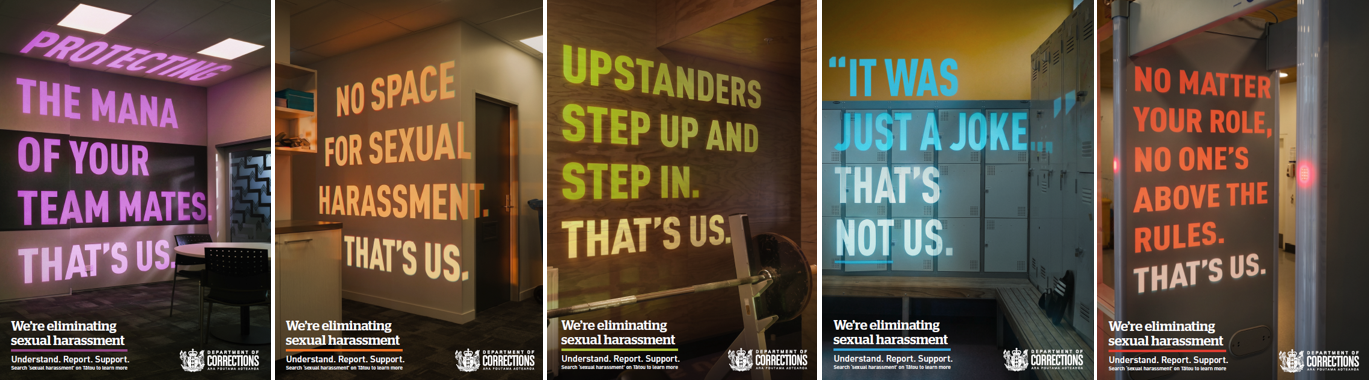
This is encouraging news and shows that our culture is starting to shift.
Feedback from workshops shows they are really resonating with our people:
- 94% of participants say they now have a better understanding of sexual harassment, and
- 88% feel more confident
- to speak up or intervene.
“I didn't even realise that was sexual harassment.”
“This workshop has helped so much... it makes me feel confident in sharing my thoughts and what I am not comfortable with.”
“To be honest, I was not looking forward to attending but knew it was the right thing to do so joined. However, I am so glad that I did. This was the best online workshop I have attended in the six years I have worked for Corrections. I have recommended it to my workmates”.
Next steps – new training for leaders
This work doesn’t sit in isolation. We will be taking the lessons we’ve learnt into our broader work on integrity, including bullying, harassment and discrimination alongside sexual harassment.
Training focused on these behaviours has been widely requested by our staff and we are currently designing a new workshop that we will look to test before rolling out to all of our people leaders initially.
The training about Creating a Positive Workplace is an interactive session which builds on information from our sexual harassment training with more in-depth content, including:
- Definitions of bullying, harassment and discrimination
- Awareness of the prevalence of these behaviours in our organisation
- Legislation that protects us
- Understanding the dynamics and the roles we all play
- Exploration of upstanding using scenarios
- Understanding culturally safe and responsive support for each other
- Living our values to create a values led culture
Why your role matters
A question I continue to hear is “Why does this matter for me?”
The way we respond in everyday situations shapes our culture and the wellbeing of our people at work. It’s about treating each other with dignity and respect. It’s about others seeing that you have the confidence to speak up and challenge poor behaviour. It’s about showing those who engage in poor behaviour that it will no longer be accepted. For me, that’s what this work is really about. Not just responding when things go wrong - but building a culture where people feel safe, respected, and able to speak up.
Lastly, I also want to thank everyone who has engaged with training, shared feedback, supported colleagues, or contributed to this work in any way. Your input is shaping what we are building and is helping us focus on what will make the biggest differences for our people.
I will continue to share our progress with you, including what is working well and where we need to do better.
Ngā mihi nui,
Rebecca