

PC1. Issues and complaints
At a glanceAbout issues and complaintsThis part of POM explains:
Things to remember about complaintsPrisoners have the right to complain about anything they want, at any time. Making complaints is one way that prisoners can tell us something is going wrong. The law requires that we do our best to resolve prisoners’ complaints. This helps keep tension low in the prison, reduces violence and aggression and keeps everyone safe. We have a “no wrong door” policy for complaints. This means that prisoners can complain to us in any way they choose. Regardless of how they complain, we will help them get their complaint into the right system and try to resolve it. Prisoners’ complaints are an important source of information for us. They help us identify any problems with our local, regional or national systems that we need to fix. We manage complaints in line with the Ara Poutama Aotearoa Complaint Resolution Policy. If a prisoner is unhappy about the outcome of a complaint they made to us, or unhappy that we have not investigated their complaint, they can ask the Office of the Inspectorate or an agency that monitors us (like the Health and Disability Commissioner, Office of the Ombudsman or Privacy Commissioner) to look at it. Where to get help and informationAll our information and resources for resolving complaints are in the Complaint Resolution Practice Centre. If you have questions about complaints, email complaintsupport@corrections.govt.nz Our approach to complaints reflects Corrections Act 2004, s 151–159 and Corrections Regulations 2005, regs 159–167. |
PC1.1 The difference between issues, complaints and allegations against staff
Issues
An issue is when a prisoner tells us they are concerned about something that we can easily solve or help the prisoner to solve.
A prisoner can tell us about an issue during a conversation, or they can tell us through the kiosk.
When a prisoner raises an issue in the kiosk, we have 24 hours to resolve it or refer it to someone else before it automatically becomes a complaint.
When a prisoner raises an issue, we try to resolve it ourselves if we can, and without escalating it into a complaint.
Complaints
A complaint is an issue that we cannot quickly and easily resolve and need to investigate.
This section of POM explains what we do when a prisoner, or someone acting for a prisoner, tells us something related to a general matter is wrong and they want us to investigate it.
Prisoner complaints about health, psychology and rehabilitation programmes
When a prisoner complains about health, psychology or rehabilitation programmes, we use the Health, Psychology and Rehabilitation Programmes Complaint Resolution Procedures.
Prisoner complaints about sexual assault by another prisoner
If a prisoner’s complaint is about sexual assault by another prisoner, we follow IR.10 Incident response – prisoner sexual assault.
Allegations against staff
An allegation against staff is when a prisoner reports that a staff member has assaulted someone, committed a crime on duty, shown a bad attitude or behaviour (conduct), or otherwise not carried out their duties.
When a prisoner makes an allegation against staff, we follow IR.07 Allegations against staff.
Find out more about the different types of allegations, and how we manage them, in IR.07 Allegations Against Staff: Category Definitions (PDF 177KB).
PC1.2 How we manage issues
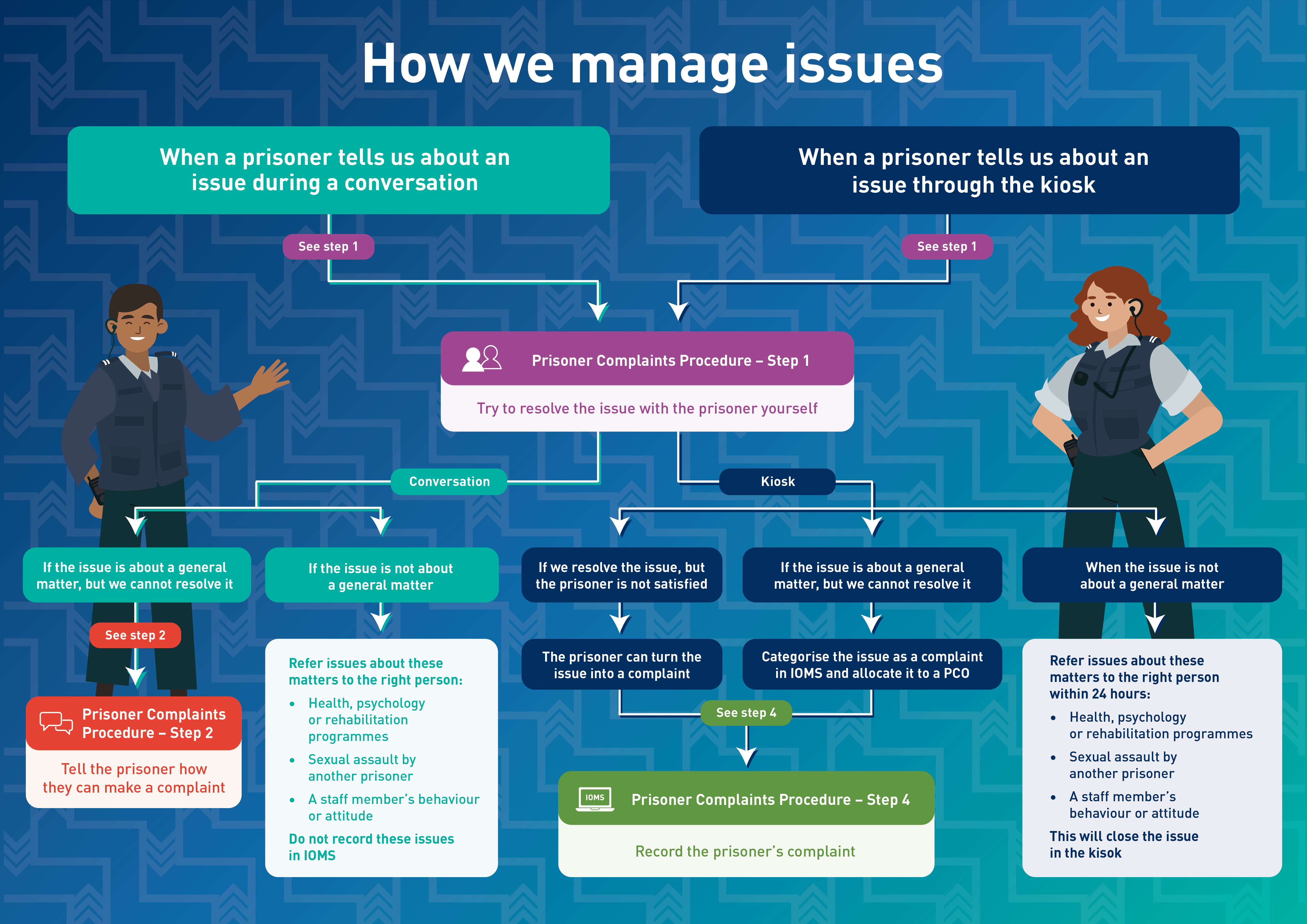
Download How we manage issues (poster) (PDF 806KB).
When a prisoner tells us about an issue during a conversation
When a prisoner tells us about an issue during a conversation, we ask them about the issue, listen to what they have to say and try to resolve their problem.
See Step 1 – Try to resolve the issue with the prisoner yourself.
If the issue is about a general matter, but we cannot resolve it
If the issue is about a general matter but we cannot resolve it, the prisoner can decide to make a complaint (see The Prisoner Complaints Procedure).
If the issue is not about a general matter
If the issue is not about a general matter (for example, it is about health, psychology or rehabilitation programmes; sexual assault by another prisoner; or a staff member's attitude or behaviour), we refer it to the relevant person. They will manage it through a different procedure (see Complaint Resolution Practice Centre).
We do not record these types of issues in IOMS.
When a prisoner tells us about an issue through the kiosk
Most prisoners tell us about an issue through the kiosk. In the kiosk, a prisoner uses the Requests and Complaints button to raise an issue.
After a prisoner raises an issue in the kiosk, we have 24 hours to resolve the issue or refer it to someone else. If we do this, and the prisoner is satisfied with our response, the issue will be resolved in the kiosk and not become a complaint.
See Step 1 – Try to resolve the issue with the prisoner yourself.
If we resolve the issue, but the prisoner is not satisfied
If we resolve the issue within 24 hours, but the prisoner is not satisfied with our response, they can use the kiosk to turn their issue into a complaint (see The Prisoner Complaints Procedure).
If the issue is about a general matter, but we cannot resolve it
If the issue is about a general matter but we cannot resolve it, we must categorise the issue as a complaint in the IOMS Kiosk Notifications screen and allocate it to a PCO.
If we do not do this within 24 hours of the prisoner raising the issue in the kiosk, the issue automatically becomes a complaint (see The Prisoner Complaints Procedure).
When the issue is not about a general matter
If the issue is not about a general matter (for example, it is an issue about a health, psychology or rehabilitation programme; sexual assault by another prisoner; or a staff member's attitude or behaviour), we refer it to the relevant person. They will manage it through a different procedure (see Complaint Resolution Practice Centre).
If we do this within 24 hours, and the prisoner is satisfied with our response, the issue will be resolved in the kiosk.